After a long hiatus of just on 12 months we're back. We will be continuing our series of weekly posts on service management for service providers. Stay tuned.
In the current economic climate, many service providers will be looking closely at their IT spend. With the Communications Index down more than 40% on where it was 12 months ago, should service providers cut back on operational support systems (OSS) and projects to automate service management? We think this is the ideal time to embark on these projects. With an economic downturn across all industries, there is an opportunity to access IT resources and personnel at a discounted rate. This provides an opportunity to take on projects that will deliver real cost savings. If you prepared a business case that didn't stack up 3 months ago, maybe it is time to revisit it. The rule as always though, is to keep projects short and focused. Deliver in small increments with quantifiable benefits at each stage and you should find you have leapt ahead of your competitors in 12 months time.
Last week a colleague asked about software quality metrics for Operational Support System (OSS) projects. A large telecommunications provider was complaining that the system that they had delivered contained too many bugs. The question that she needed answered was "How many bugs is too many?" . In answer to this question she wanted some benchmarks for industry best practice in terms of bugs per lines of code (LOC). Before examining this question, we thought we should look at some of the characteristics of OSS projects, including: Typically they are large in terms of code base and time to deliver; They are complex ; They are highly customised ; They are expensive and; They deliver strategic benefits to the service provider. In situations such as these we start by looking at the customer's real concerns - there is usually an underlying problem that elicits the response "Your system contains too many bugs" . Here is a quick checklist:...
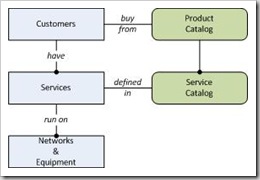
Following on from our previous post on Service Modelling , we thought we would discuss the service catalog. Wait, is that a service catalog or a product catalog? If you remember, a product is something we sell to a customer. Most businesses would be familiar with a product catalog. At a restaurant the product catalog is called a menu. For some reason, telecommunications service providers struggle with the concept of the product catalog and this is usually because they confuse the definitions of products and services. The product catalog should contain all the items you advertise and sell to your customers. There are usually many more products than service types, as each product has a unique set of pricing information. If you sign customers up for fixed term contracts for example, each contract length defines a different product, even though the type of service provided to the customer is the same. The service catalog on the other hand is what drives the operational side of the...

In the end, schedules slip, things break, customers are unhappy and developers are stressed.essay checker
ReplyDelete